An open protocol for composable, provable on-chain games
Each game reinvents token minting, score tracking, settings management, and lifecycle control from scratch.
Platforms write custom integration code for every single game. N games means N integrations.
No standard way to find, query, or understand what a game can do. Zero programmatic introspection.
Every game speaks the same four words
The universal language of games. Points, time survived, distance — one interface for all.
Difficulty, rules, modifiers. Permissionless configuration that anyone can create.
Start, play, end — the rhythm every game follows. Time windows for tournaments and quests.
Goals, achievements, and win conditions. Permissionless quests anyone can define and verify.
"EGS does not invent new concepts. It gives existing ones a shared shape."
Every game outcome becomes a token. Owned by the player, readable by any contract.
Players hold their game outcomes directly in their wallet. No platform custody, no accounts to lose.
Tokens can be traded, gifted, or sold the moment they're minted. Every achievement has a market.
Each token is minted on-chain with immutable proof of what happened, when, and by whom.
251 bits. One felt252. Every field encoded in the ID itself.
All metadata lives in the token ID itself. Zero storage cost for immutable game data.
Any frontend can unpack the ID without RPC calls. Instant metadata access on any client.
Any contract can decode any token without knowing the source. Self-describing IDs enable permissionless interop.
Every token renders its own rich metadata card. Fully on-chain.
"Free games maximise distribution. Platforms monetise the experience."
Deploy contract, register with MinigameRegistry
Query registry, SRC5 reveals capabilities
One SDK, one set of hooks for every game
// Discover all registered games const { games } = useGames(); // Fetch tokens for any game const { tokens } = useTokens({ gameId }); // Subscribe to real-time score updates const { lastEvent, events } = useScoreUpdates({ gameIds: [gameId] });
When games speak a standard language, AI can play
Agents query the MinigameRegistry to find all available games and their metadata.
SRC5 introspection tells the agent exactly what interfaces a game supports.
Every token can be provided with skills that teach agents how to play the game.
Standard lifecycle and scoring works identically across all games. No per-game code.
"One standard interface means one agent can play every game."
Games as interconnected nodes, not isolated apps
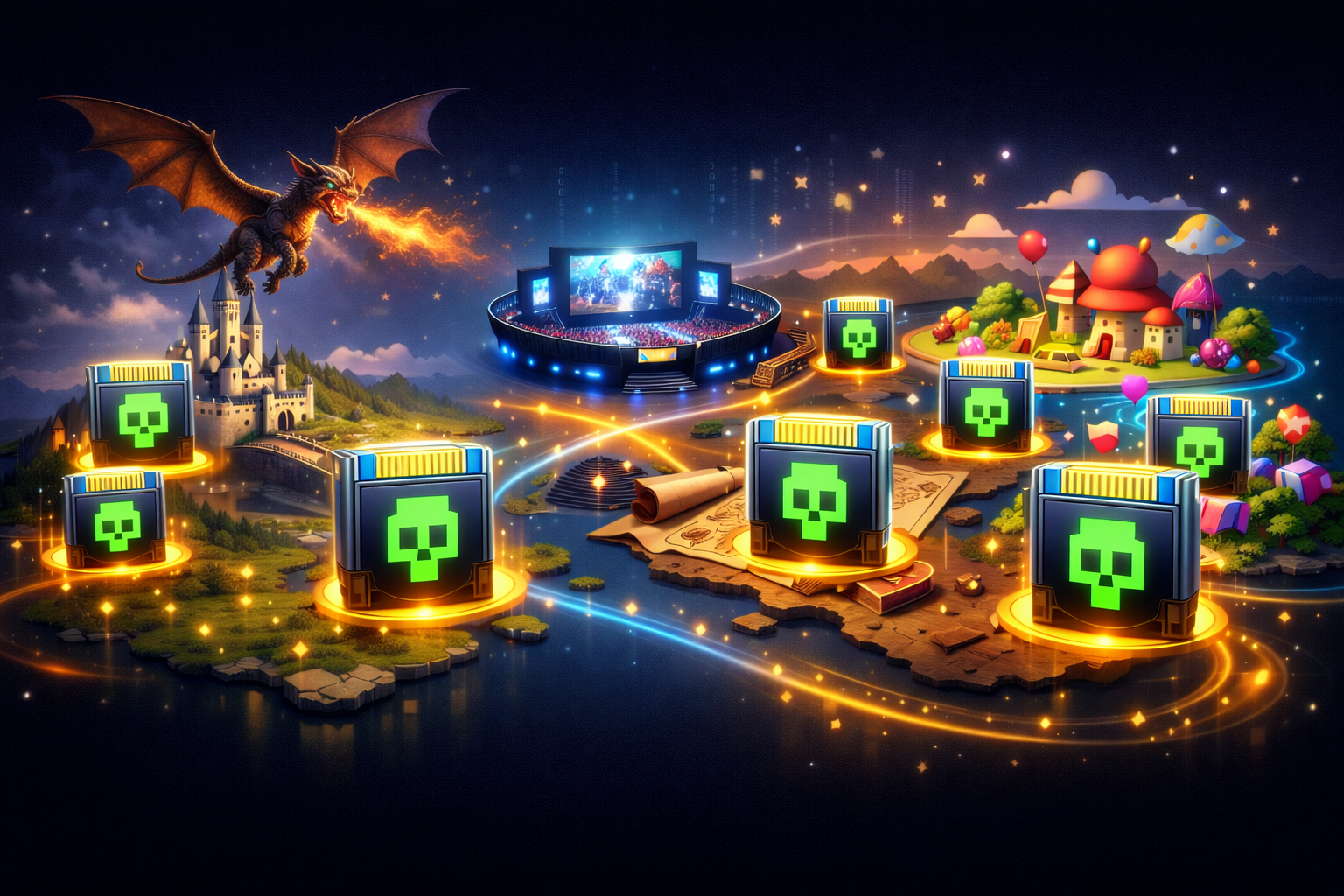
Real games. Real platforms. One standard.
Turn-based collectible card game. Build your deck, battle monsters, and explore.
Fight beasts and obstacles in a procedurally generated dungeon crawler.
Puzzle game where players manipulate blocks to form solid lines and earn points.
Sequential puzzle game. The first layer-3 appchain built on Starknet.
A decentralized, hip-hop culture-infused on-chain metaverse inspired by Drug Wars.
Permissionless tournament protocol with entry fees and prize structures.
On-chain quest DAG system. Define quest chains, track cross-game progress, unlock rewards.
MMO embedding EGS games as quests. A connected gaming universe.
The standard is open. The tools are ready. Start building.
PROVABLE GAMES